
New Technology · November 2026
The Autonomous Office: Integrating AI with Smart Building Infrastructure
Discover how the fusion of AI and IoT is transforming workspaces in 2026, driving unprecedented energy efficiency, security, and employee wellbeing through autonomous infrastructure management.
The Autonomous Office: Integrating AI with Smart Building Infrastructure
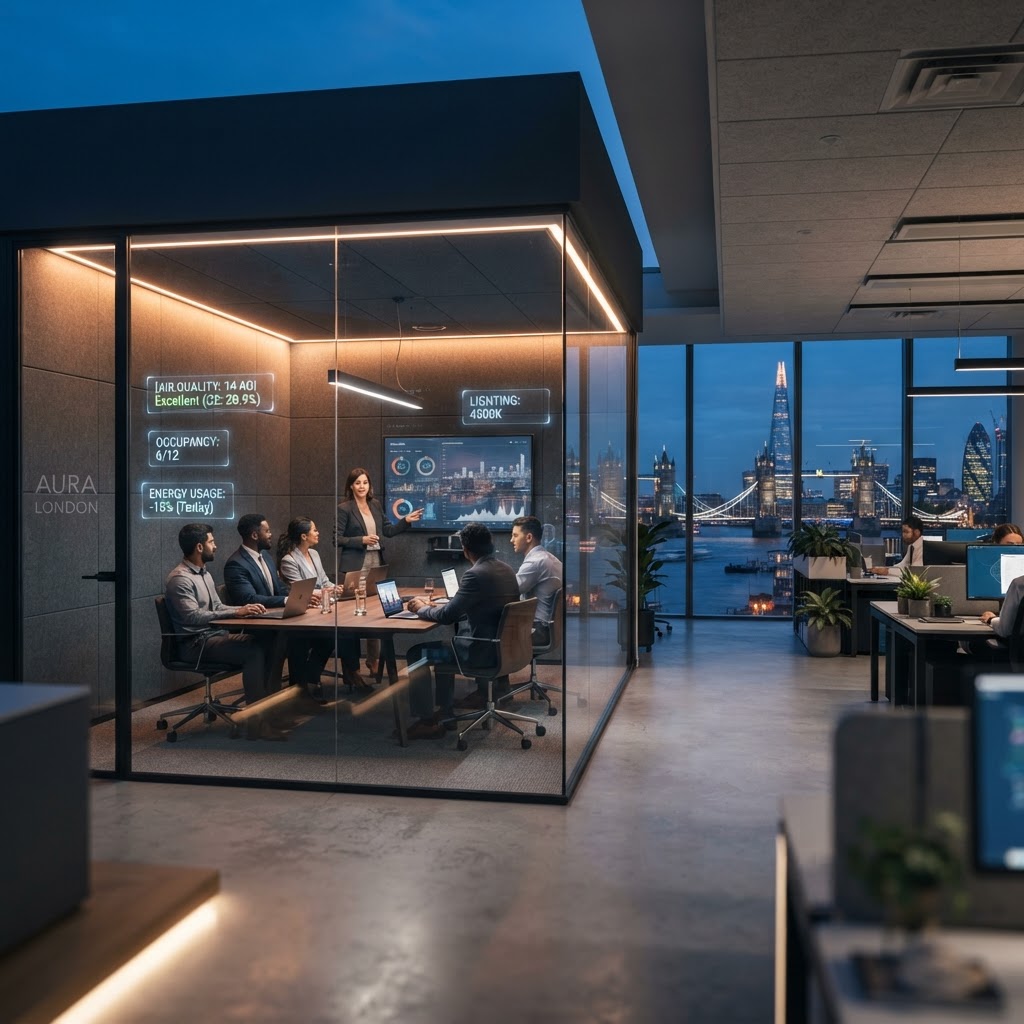
As we reach the midpoint of 2026, the concept of the 'Smart Building' has evolved into the 'Autonomous Office.' At iwGROUP, we are seeing a significant shift: it is no longer enough for technology to simply report data; it must now act upon it in real-time. By converging IoT sensors with advanced AI-driven management layers, businesses are creating workplaces that intuitively respond to the needs of their occupants and the requirements of the environment.
The Convergence of IW-Core Technologies
True autonomy requires a holistic approach to building systems. The silos that previously separated iwSENSE (building automation) from iwGUARD (security) and iwMEDIA (AV/Signage) are collapsing. In the modern office, your lighting, HVAC, access control, and booking systems are now communicating through a unified, secure fabric.
- Predictive Energy Management: Using machine learning models, your HVAC system now learns the thermal inertia of your office space. It anticipates occupancy fluctuations based on calendar integrations, pre-cooling or heating zones only when necessary, slashing energy waste by up to 30%.
- Dynamic Workspace Allocation: Through iwMEDIA and sensor arrays, real-time occupancy data now drives automated signage that guides employees to available collaborative spaces, while simultaneously adjusting local air quality settings for maximum productivity.
Security in the Age of Autonomy
With increased connectivity comes the requirement for robust protection. The integration of iwGUARD with AI-based video analytics has moved security from reactive to proactive. Modern systems now utilise edge-AI to distinguish between routine foot traffic and potential anomalies, such as unauthorised tailgating or environmental hazards.
By leveraging iwTECH cybersecurity standards—specifically Zero Trust Architecture—these smart systems ensure that the building's infrastructure remains isolated from critical corporate networks, preventing lateral movement in the event of a breach.
The Human-Centric Workplace
Technology is only valuable when it supports the workforce. The most effective 2026-era offices use iwCONNECT and smart sensing to facilitate 'frictionless' workflows.
- Voice-Activated Environmentals: Employees can adjust their personal micro-climate or meeting room acoustics using natural language commands integrated directly into the building management platform.
- Wellbeing-Focused Automation: CO2 levels and light intensity are dynamically adjusted throughout the day, aligning with circadian rhythm science to maintain focus and reduce fatigue.
Preparing Your Infrastructure
To move toward an autonomous office, businesses must prioritise the 'digital backbone.' Connectivity is the foundation. Without high-bandwidth, low-latency networking, the vast data streams required by AI building managers will lead to bottlenecking.
At iwGROUP, we recommend a three-phased approach to achieving autonomous maturity:
- Audit & Unify: Identify the disparate systems currently running in your office. Ensure they support open protocols like BACnet, MQTT, or industry-standard APIs.
- Secure the Edge: Deploy robust cybersecurity measures. Every new smart sensor is a potential access point; treat them as such.
- Data-Driven Iteration: Implement a centralised dashboard that aggregates data from your specialist systems (Print, Security, AV, and SENSE) to gain a single view of your workplace performance.
Conclusion
The autonomous office is not a distant vision—it is an actionable strategy for 2026. By bridging the gap between your physical assets and intelligent software, you unlock new levels of efficiency, security, and employee satisfaction. Whether you are retrofitting a historic London workspace or designing a new headquarters, the integration of intelligent technology is the defining factor in remaining competitive in the modern commercial landscape.