
Industry Insight · November 2026
The Autonomous Office: Integrating IoT and AI for the 2026 Workplace
Discover how the convergence of AI, IoT, and smart building management is redefining operational efficiency and employee wellbeing in the modern UK workplace.
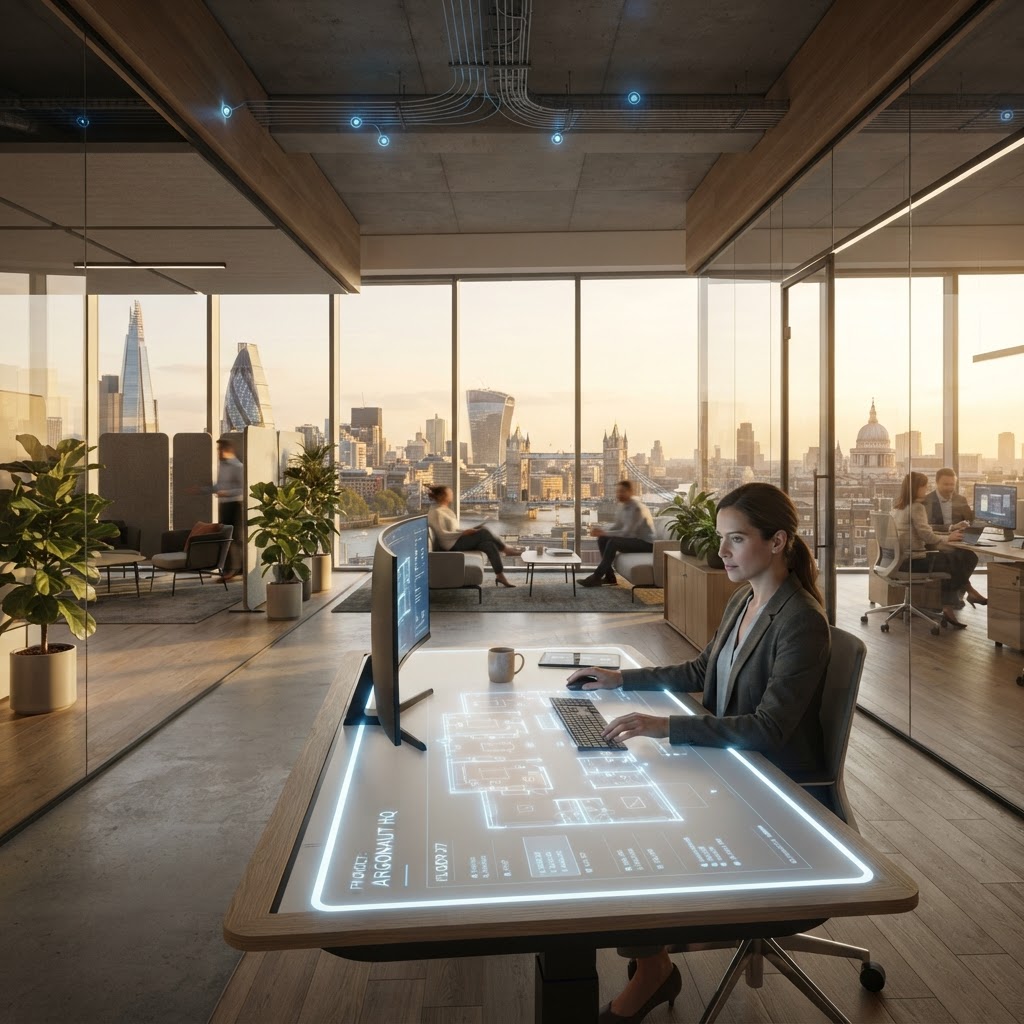
The Autonomous Office: Integrating IoT and AI for the 2026 Workplace
As we navigate the second half of 2026, the concept of the 'Smart Office' has shifted from a collection of fragmented gadgets to a unified, autonomous ecosystem. For UK businesses, the pressure to optimise energy consumption, ensure robust cybersecurity, and foster hybrid collaboration has reached a critical intersection. At iwGROUP, we are seeing a fundamental shift towards buildings that do not merely house employees but actively manage their own environments to boost productivity and sustainability.
The Convergence of Proptech and Human-Centric Design
Modern workplaces are now governed by iwSENSE-driven automation. By integrating HVAC, smart lighting, and occupancy-based spatial awareness, businesses are achieving energy savings that align with the stringent Net Zero targets set for the coming decade. In 2026, air quality monitoring—using sensors linked to CO2 and particulate matter thresholds—is no longer a 'nice to have'; it is a standard health and safety requirement. When internal air quality drops, the building's management system automatically adjusts intake levels, directly correlating with improved cognitive performance for staff.
Intelligent Security in an Interconnected World
As digital and physical perimeters blur, iwGUARD solutions have evolved to leverage AI-powered behavioural analytics. Traditional CCTV has been replaced by integrated security meshes that use:
- Biometric Access Control: Removing the need for physical fobs or cards in favour of secure, encrypted mobile credentials.
- AI Threat Detection: Differentiating between standard movement and security breaches through machine learning patterns.
- Hybrid Security: Blending remote sensor monitoring with SIA-licensed personnel to ensure rapid incident response.
The Evolution of the Digital Workspace
Connectivity is the backbone of the autonomous office. With the widespread adoption of Wi-Fi 7 and advanced 6G-ready infrastructures, businesses are utilising iwTECH to ensure zero-latency environments. This is essential for the seamless operation of iwMEDIA solutions, such as interactive video walls and acoustic-optimised podcast booths, which serve as the physical nodes for global remote teams.
For organisations looking to standardise their hybrid model, we recommend a three-pillar strategy:
- Unified Communications: Integrating AI-powered telephony via iwCONNECT to ensure voice analytics provide actionable insights into customer engagement.
- Optimised Creative Workflows: Utilising iwPRINT’s colour calibration and contract proofing technology to maintain enterprise-grade quality standards in a digitised print environment.
- Strategic IT Governance: Engaging a Virtual CTO to oversee the cybersecurity landscape, ensuring that IoT devices do not create vulnerabilities in the corporate network.
Achieving Operational Excellence
To succeed in 2026, leadership must view technology as a holistic investment rather than a siloed expense. By synchronising building automation with workforce management tools, companies can create a responsive, resilient, and human-centric environment. The goal of the autonomous office is not to remove the human element, but to strip away the environmental and administrative friction that prevents teams from performing at their best.
As we move towards 2027, the focus must remain on interoperability. Ensure your technology stack speaks one language, supported by robust security protocols and proactive maintenance strategies. Your workplace is your most valuable asset; ensure it is working as hard for you as your employees are.