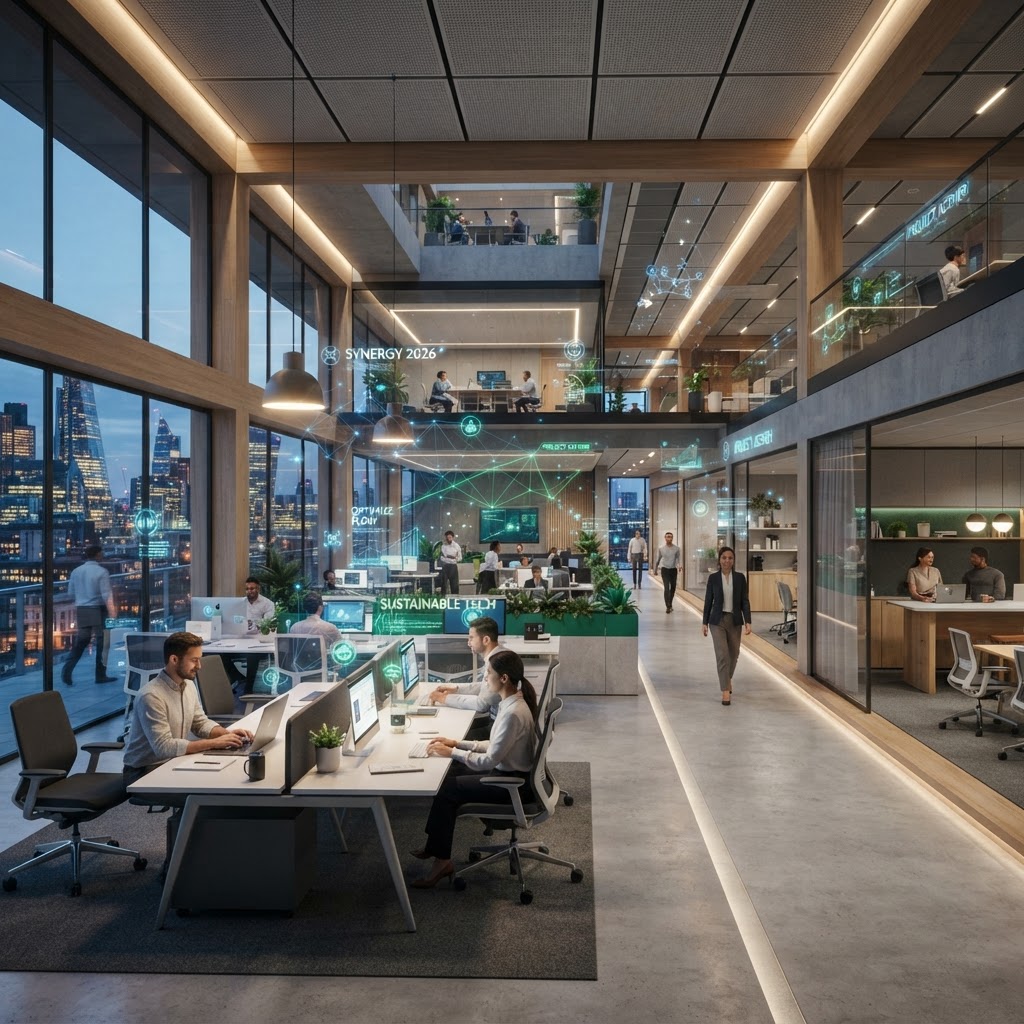
The Rise of Cognitive Buildings: Mastering Energy & Experience in 2026. The office is no longer merely a place of work; it has become an active, living organism. In the landscape of mid-2026, the term 'smart building' feels somewhat dated. We have moved firmly into the era of the Cognitive Building—a workplace that doesn't just automate tasks but actively 'thinks' to optimise both operational efficiency and human performance. For UK-based organisations, this shift is critical. As we navigate the complex intersection of Net Zero mandates, evolving workplace hybridity, and a focus on employee wellbeing, the integration of intelligent infrastructure is no longer a luxury; it is a competitive imperative. ### The Core Architecture of Cognitive Workplaces. A cognitive building functions through a unified digital nervous system. At iwGROUP, we have observed that the most effective environments are those that bridge the gap between building management systems (BMS) and end-user productivity platforms. This convergence is built upon several foundational pillars: 1. Hyper-Personalised Proptech: Using ultra-wideband (UWB) sensors and occupancy analytics, spaces now adjust lighting and thermal comfort based on individual preference or real-time density. 2. Energy-as-a-Service (EaaS): AI-driven HVAC control now utilizes predictive weather data and historical occupancy patterns to slash carbon output by up to 30%, meeting strict ESG targets. 3. The Human Experience (HX) Overlay: Meeting room booking systems now interface directly with digital signage and acoustic tuning, ensuring that every hybrid collaboration is frictionless. ### Bridging the Physical-Digital Divide. One of the most significant shifts we have managed recently involves the integration of iwSENSE with iwMEDIA. It is no longer enough to have a smart lightbulb or an occupancy sensor. The value is found in the integration of the two. For example, when an AI-driven booking system detects a high-intensity brainstorming session in a creative studio, the cognitive environment automatically adjusts the acoustic dampening and modulates the lighting temperature to 5000K to encourage focus and high-energy performance. Conversely, for quiet reflection zones, the system softens acoustics and adjusts the air filtration rates to promote cognitive ease. ### Cybersecurity in the Cognitive Age. With an increase in connected devices (IoT), the attack surface for the modern office has expanded exponentially. The traditional perimeter firewall is obsolete. In 2026, we advocate for a Zero Trust Architecture that extends from the core network down to the smart coffee machine in the breakroom. Under the iwTECH framework, we ensure that every sensor and gateway is segmentised. If an IoT device is compromised, it cannot serve as a lateral entry point into your core CRM or financial databases. Security is no longer just digital; as part of our Specialist Security services, we align physical access control with digital authentication protocols to ensure that identity management is holistic and foolproof. ### The Future of Occupancy Analytics. We are seeing a move away from 'passive occupancy' to 'predictive intent'. By leveraging advanced voice analytics and movement sensors, companies can now understand not just that a room is occupied, but how the space is being used. Are teams collaborating, or is the space being used for solitary deep work? This data is transformative for lease strategy and office design, allowing businesses to right-size their footprint while simultaneously increasing the quality of the spaces they retain. ### Practical Steps for Implementation. Transitioning to a cognitive building model does not require a total rip-and-replace of your infrastructure. Instead, follow a modular approach: 1. Audit and Integrate: Begin by connecting your siloed systems. Can your access control communicate with your HVAC? If not, that is your first project. 2. Standardise Protocols: Ensure your systems speak the same language. Shift toward open-source protocols like BACnet/SC to ensure future-proof interoperability. 3. Focus on Wellbeing: Use data to measure the 'soft' metrics. If employees report higher satisfaction in areas with better IAQ (Indoor Air Quality), scale those specific settings across the entire floorplate. 4. Professional Management: Technology requires oversight. Through our Virtual CTO and managed service offerings, we provide the continuous optimisation required to ensure that your building's 'intelligence' does not stagnate. The buildings of 2026 are not about gadgets; they are about outcomes. By placing technology in service of both the planet and the people who inhabit these spaces, we can create a workplace that is truly future-proof. At iwGROUP, we continue to guide our clients through this technical evolution, ensuring that your office remains your greatest asset in attracting and retaining talent.